The Bluegrass Dobro (Resonator Guitar)
There is nothing quite like the sound of a resonator guitar played with a steel bar. It doesn’t just blend into the band; it sings above it. The tone is smooth but cutting, vocal but metallic, capable of both deep expression and driving rhythm. When a dobro player takes a solo, the music doesn’t just continue — it often feels like it starts speaking.
Why is it called a Dobro?
One of the more colorful chapters in the history of the instrument involves the Dopyera brothers, a group of Slovak-American inventors who were instrumental in developing the resonator guitar in the late 1920s. Originally working with George Beauchamp on the National guitar, the Dopyeras designed metal-bodied resonator instruments to compete with horns and other loud instruments in pre-amplification ensembles. After a business split, they went on to form their own company and introduced a wooden-bodied version with a single resonator cone, which they branded “Dobro” — a contraction of DOpyera BROthers (and also conveniently meaning “good” in Slovak).
The business side of the story was anything but smooth. The Dopyeras were deeply involved in patent disputes and legal battles over resonator designs, aggressively protecting their inventions and competing directly with National and other manufacturers. As a result, “Dobro” became not just the name of a company, but a trademark that was actively defended in court. Even today, the term “dobro” is technically a brand name, though it is often used generically to refer to resonator guitars. The combination of innovation, competition, and legal wrangling is a reminder that even in the world of acoustic music, the instruments themselves often have stories as complex as the music they produce.
Why It Sounds Like That
The distinctive sound of the dobro comes from two key design features: the resonator cone and the lap-style playing position.
Unlike a standard acoustic guitar, which amplifies sound through a wooden soundboard, the dobro uses a spun metal resonator cone to project sound. Vibrations from the strings are transferred through the bridge into this cone, which acts like a mechanical speaker. The result is a tone that is:
- louder
- more focused
- more metallic
- and highly directional
This gives the dobro its ability to cut through a band even without amplification.
The second defining feature is how the instrument is played. The dobro is laid flat across the player’s lap, and instead of pressing the strings down to the fretboard, the player uses a steel bar to glide across them. This creates a smooth, continuous pitch that can move seamlessly between notes.
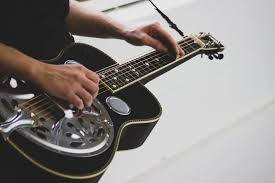
Note that in order for this to work, the strings have to be suspended above the “fretboard” at a much higher distance than other fretted instruments. If you look at a side view of a dobro, you’ll see that the strings are above the fingerboard at about an inch. It would be impossible to fret a string to select a note on a Dobro by pressing down with your fingertip, but it is perfect if you are using a steel bar to do so.
The result is a sound that can bend, slide, and sustain in ways that no fretted instrument can.
How the Dobro Works
Dobro playing is built around a very different physical approach than guitar or banjo.
As described above, the left hand does not fret notes in the traditional sense. Instead, it holds a solid steel bar that rests on top of the strings. By sliding this bar along the strings, the player controls pitch. This allows for:
- glissando (smooth sliding between notes)
- vibrato (subtle pitch variation)
- expressive phrasing
- muting and/or ending a note’s sustain (by the palm of your left hand)
The right hand uses fingerpicks — typically thumb and two fingers — to pluck the strings. It controls:
- timing
- tone
- articulation
- dynamics
Because the strings are not pressed to the fretboard, intonation is entirely dependent on the player’s ear and precision. There are no frets to “catch” the note. It must be placed exactly.
This makes the dobro both expressive and unforgiving.
The Dobro’s Role in Bluegrass
The dobro occupies a unique space in a bluegrass band. It is neither purely rhythmic nor purely melodic — it moves fluidly between roles.
In backup, the dobro often plays:
- sustained chords
- subtle fills between vocal lines
- sliding harmonies that support the singer
Unlike the mandolin chop or the guitar strum, dobro backup can be percussive when needed, or textural and supportive, adding color. A percussive backup is needed in situations where, for example, the mandolin is taking a lead break and cannot supply the “chop” offbeat – and in this case the Dobro can fill in with a similar “chop” (or maybe it ends up sounding more like a “whack”).
In lead playing, however, the dobro becomes one of the most expressive instruments in the band. Its ability to sustain and shape notes allows it to:
- closely mimic the human voice
- emphasize emotional phrasing
- create lyrical, flowing solos
Where the banjo drives and the guitar anchors, the dobro often sings.
Timing and Tone
Because the dobro can produce sustained notes, timing is experienced differently.
A banjo player defines timing through the spacing of many notes. A dobro player defines timing through:
- when a note begins
- how long it is held
- how it connects to the next note
This makes phrasing critically important. A great dobro player can make a simple line feel deeply expressive just through control of timing and sustain.
Note that some advanced Dobro players can play very percussively, even while issuing a spree of notes at high speed using a technique called blocking. This is similar to the aforementioned technique where the dobro takes over the mandolin chop and is done with a muting motion using the left hand. It sounds really cool and if you have ever heard Josh Swift play, you’ll know what I’m talking about. Check out this video of Josh doing a ton of blocking at light speed.
Tone is equally important. Small changes in right-hand attack or bar pressure can dramatically affect the sound. Great players develop:
- clean attack
- controlled sustain
- consistent intonation
- expressive vibrato
The Language of the Dobro
Like the other instruments in bluegrass, the dobro has its own vocabulary.
This includes:
- signature slides into notes
- hammer-ons and pull-offs (with the bar and right hand)
- roll patterns similar to banjo
- chord-based licks and fills
- blocking while issuing a phrase of fast notes
But unlike the banjo or guitar, the dobro’s vocabulary is less about fixed patterns and more about phrasing and expression.
Two players can play the same notes and sound completely different.
From Josh Graves to Today
The modern role of the dobro in bluegrass can be traced directly to Josh Graves.
Before Graves, the resonator guitar was used primarily in country and Hawaiian music. Graves, playing with Flatt & Scruggs, adapted the instrument to fit the bluegrass sound. Most importantly, he borrowed ideas from Earl Scruggs’s banjo style — including roll-based right-hand patterns — and applied them to the dobro.
This was a breakthrough moment. It allowed the dobro to function within the rhythmic and melodic framework of bluegrass, rather than sitting outside it.
Later players expanded on this foundation.
Mike Auldridge brought a new level of tone, taste, and musical sophistication to the instrument. His playing was smooth, controlled, and deeply musical, helping to establish the dobro as a serious voice in bluegrass.
Jerry Douglas then took the instrument to another level entirely. Combining technical mastery with an expansive musical vision, Douglas pushed the dobro into new territory, incorporating elements of jazz, blues, and contemporary acoustic music. Much like Béla Fleck did for the banjo, Jerry Douglas demonstrated that the dobro could operate far beyond its traditional boundaries.
More recent players such as Rob Ickes and others have continued to refine and expand the instrument’s role, combining tradition with modern technique and musical awareness.
What to Listen For
Listening to a dobro player requires a different kind of attention than listening to banjo or guitar.
First, listen to tone. Is the sound clean, full, and controlled? Are the notes clear and well-defined?
Next, listen to intonation. Because there are no frets, every note must be placed precisely. Even small inaccuracies are noticeable.
Then listen to phrasing. Does the player shape lines in a way that feels natural and expressive? Do the notes connect smoothly?
Also pay attention to timing and sustain. Does the player control when notes begin and end in a way that supports the band?
Finally, listen for taste and restraint. The dobro is capable of drawing a lot of attention. Great players know when to step forward — and when to stay out of the way.
Final Thought
The dobro is one of the most expressive instruments in bluegrass. It brings a vocal quality to the music that no other instrument quite matches.
When played well, it doesn’t just add notes to the band.
It adds emotion.