The Fiddle’s Fascinating Facets
Did you ever try to draw a bow across a fiddle? If you can do it just right it will induce quite a beautiful sound… but it takes just the right touch. And if you don’t have just the right touch, you get this heinous sound of tortured cats that we all associate with novice violinists.
In this chapter, I will be covering the devil’s instrument in some detail. Let’s start with a few things you might want to know about bluegrass fiddling.
How Does a Bowed String Make a Sound?
I have often wondered why a violin string makes a sound when horsehair is drawn across it (yes, actual, real, authentic horsehair is used in violin bows). Hermann von Helmholtz pondered the same thing in 1877 and figured it out. Here is a slow-motion video of a bowed violin string – one that von Helmholtz could never have made in his day.
Check out this ultra-slow motion video and you can easily see the mechanics involved. The bowed string works through a fascinating stick-slip mechanism and it is just fascinating to see in slow motion. The horsehair grips the string and pulls it sideways until the tension becomes too great. The string then slips free, snaps back, and is caught again by the bow hair. This process repeats rapidly, creating a stable vibration.[1]
What makes the horsehair grip and release the strings, you might ask. Well, first of all, a good violinist will apply rosin to a bow before using it. Rosin is basically tree sap from coniferous species of trees and tree sap is, well, sticky. (It is considerably more complicated than that but details are kept as a dark secret by good rosin craftspeople.)
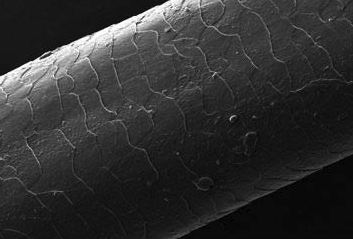
Secondly, horsehair has a very interesting micro-structure. The picture below is a single strand of horse’s hair under a microscope. See those little edges? Those are the ones that catch the string in the manner that Helmholtz describes. And when you install horsehair onto a bow, each strand of hair has to be oriented in the opposite direction from its neighbor (otherwise it would only produce a tone in one direction).
When you have hundreds of sticky horsehair fibers scraping against steel violin strings, at just the right speed and with just the right force, you get a beautiful tone emerging from the violin. That tiny controlled chaos is then transferred through the bridge into the body of the instrument, which amplifies and colors the sound.
What sounds smooth to our ears is, in reality, a continuous microscopic cycle of grabbing and releasing. Just like Helmholtz said.
The Not So Basics
Now that we understand the basics of tone production with bow and fiddle, let’s next see what it takes to play a tune. I have found that learning to actually produce even a single note on the fiddle is quite a bit harder than the other instruments associated with bluegrass. One of the first obstacles that the novice violinist is likely to encounter is simply holding the instrument. You probably wouldn’t have thought of jamming an instrument under your chin as a way to hold it while performing. However, this technique does seem to be the only way in which to secure a violin that frees up both hands for playing purposes. Unless of course you are playing old time music, where any combination of chest, arms, legs and torso to secure the fiddle is considered legitimate.
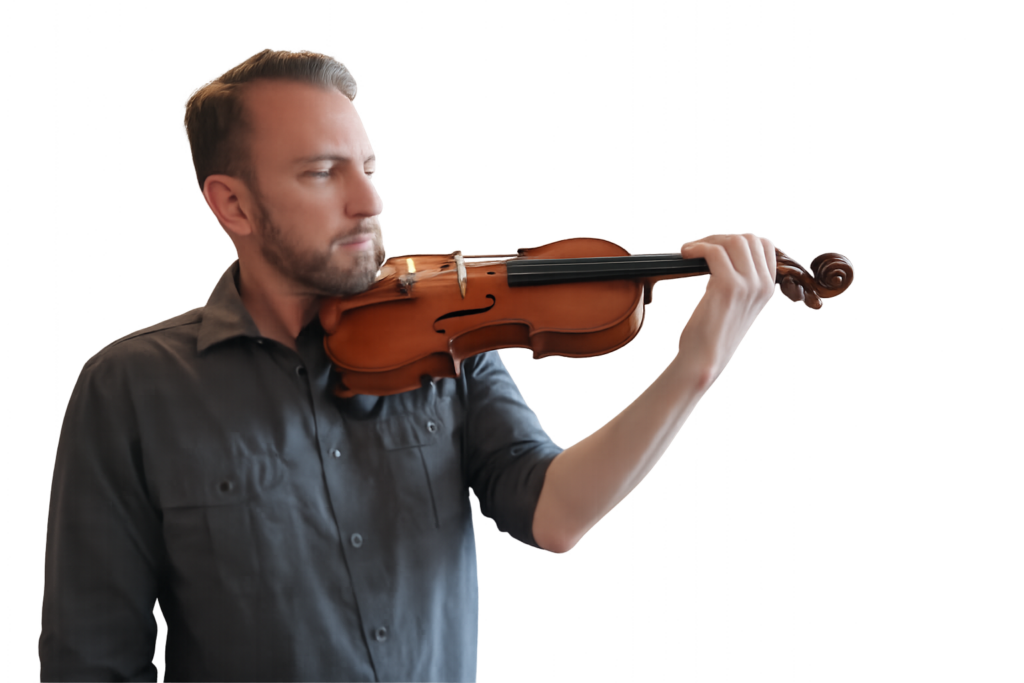
Once the violin is securely wedged under their chin, your fiddler will want to conjure up some good Helmholtz motion on one of their strings. Producing a non-scratchy note is not an easy task. First there is the bow grip, which is particularly awkward and difficult to do[2].
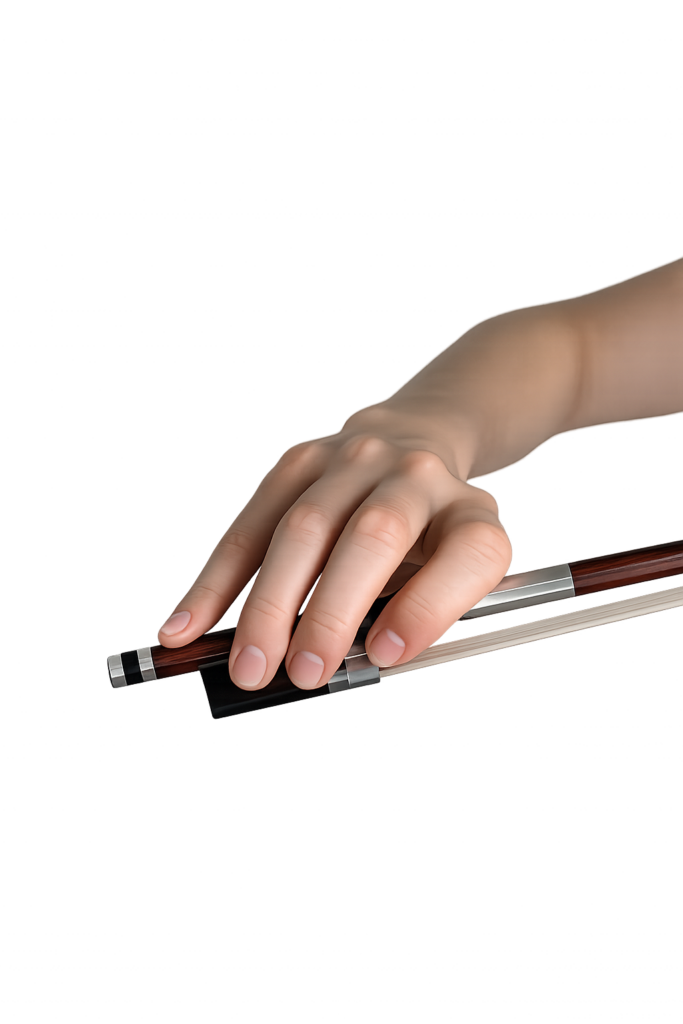
So, how do you hold a bow? Not like a baseball bat (unless you are Michael Cleveland who somehow gets spectacular tone by doing exactly that) but instead, you have to hold it like the picture above. This is anything but natural to do. And, think about the geometry of the human arm and hand, and how it must change as the bow is drawn across the strings. Just about every one of the 37 joints in the right arm, wrist, hand and fingers are required to move in a highly coordinated fashion in order to achieve the required precision. Believe me, it is much simpler to manipulate a flatpick, easily gripped between forefinger and thumb and situated less than one inch away from a string that merely has to be set in motion with a single stroke.
Once the bow is properly gripped, three independent variables must be addressed simultaneously while it is moving across the strings:
- The contact pressure between the horsehair and the string must be modulated very precisely.
- Bow speed and direction must be controlled without any flutter or shaking.
- Distance of the contact point of the bow from the bridge must be maintained to a high degree of precision.
Too much pressure and the tone chokes. Too little and it whispers weakly. Too close to the bridge and the sound becomes edgy. Too far away and it loses focus.
Keeping a Constant Force on the String
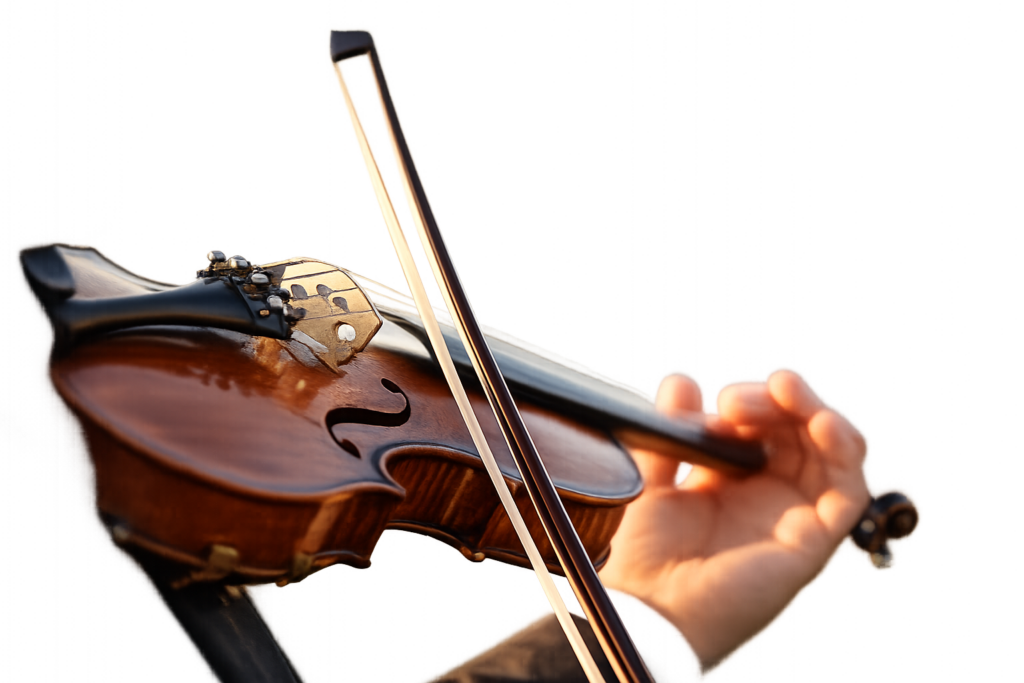
Producing a smooth, even tone with the bow is more difficult than it first appears because the natural downward force of the bow on the string is not constant throughout the stroke. As the bow moves from frog (the place where you hold the bow) to tip (the far end of the bow), the balance and leverage of the bow change continuously, and the player must compensate for those changes in real time. [3]
At the frog —the beginning of the stroke, where the hand is closest to the strings—most of the bow’s weight is extended outward beyond the fiddle like a cantilever. This increases the natural pressure of the bow on the string, often more than is desirable. If left uncorrected, the tone can become heavy, harsh, or choked. To counter this, the player lightens the pressure by using the pinky finger on top of the bow as a subtle balancing control.
At the tip—the far end of the stroke, where the hand is furthest from the strings—that leverage largely disappears. The bow now exerts much less natural weight on the string, sometimes too little to maintain a full tone. At that point, the player often adds support through the index finger, transferring a bit more controlled pressure into the string.
To sustain a clean, uninterrupted note from one end of the bow to the other, the fiddler must continuously and almost invisibly adjust these opposing forces. The pinky gradually releases control as the stroke moves outward, while the index finger gradually assumes more responsibility. Done well, the listener hears only a smooth singing tone. Done poorly, the violin may issue a sound best left undescribed.
The left hand
You may have noticed the lack of frets on a fiddle fingerboard and this is indeed, yet another obstacle that presents itself to the inchoate fiddler. In a fretted instrument, such as a guitar, frets (which are little metal bars embedded in the fingerboard) control the pitch of a string absolutely – the exact position of the fret guarantees the resulting note will be in tune (assuming the instrument is in tune to begin with) just as long as your finger is somewhere, approximately, behind the fret. Not a lot of precision is required to get an in-tune note. On the fretless fingerboard of the fiddle, however, fingers must be precisely placed to play in tune. This is quite a chore to do when your left arm is contorted like a pretzel underneath your violin. Once the fingers have been placed, slid or hammered on in the right spots, the violinist must soften the note with a bit of vibrato – and this will involve engagement of all 37 joints of the left arm, wrist, hands and fingers in another completely unnatural set of, in this case, pretzel-shaped movements.
All of the above must be mastered simply to eek out a decent rendition of “Mary Had a Little Lamb.” Have you considered playing a harmonica instead?
Intimating Intimidating Intonation
We mentioned in the last section that playing an instrument from the violin family is made even more challenging because it doesn’t have frets. Unlike, say a guitar or banjo, the lack of frets on a fiddle forces the player to be continuously tuning each note by slight finger movement up and down the fingerboard.
They now make these electronic tuners that clip onto the body of your fiddle so you can see the readout while you are playing. This is a tempting way for a budding fiddler to get an approximate idea of where to put one’s fingers, but it is a bad idea to continue to use this technique to develop great intonation. In order to see why, we will have to dip briefly into the complex topic of temperament. No, not the bad temperament your fiddler has developed while learning the gyrations described above, but the good temperament of frequencies of sound to form western musical scales.
Very briefly, temperament can be defined as the tweaking of notes to be sharp or flat so that instruments can sound in tune in a specific application such as, say, bluegrass music. There are several temperament schemes that are applicable to bluegrass music, the most important of which are equal tempering, Pythagorean tempering and just tempering.
Your electronic tuner uses equal temperament, which allows an instrument like a keyboard or guitar to play in any key. It is basically splitting the difference in all the keys and this averaging allows playing in different keys without retuning. A fiddle, however, can do better than that and when playing melody, it sounds much better to use Pythagorean temperament. That is, until two or more strings are played at once (called a double-stop) and in this case, in order to sound true, the fiddler will have to switch to just temperament. A more detailed description is beyond the scope here but Dr. Sassmanshaus has an informative tutorial of these three temperaments if you are interested <link>.
The important point is this: great fiddlers do not merely hit notes. They shape pitch according to musical context.
This is one reason why a fine fiddler can sound more “in tune” than an electronic tuner.
The Many Different Flavors of a Fiddle Note
A single note produced on the fiddle has quite a few dimensions in addition to the obvious vanilla, chocolate and strawberry flavors of pitch, duration and loudness. Listen closely to how a note begins. It may arrive with a tiny bite of bow noise that gives it definition. It may emerge invisibly through a silent bow change and seem to appear from nowhere. It may swell after the attack. It may fade like breath.
Notes can be slurred by playing multiple fingerings in a single bow stroke. Volume can be changed for dramatic effect during long bow strokes. Trills, triplets and other decorations can be added fluidly at any point during a single bow stroke or with separate bow strokes without worrying about pick direction. Generally speaking, none of these additional flavors are available to your plectrum holding peers, and when used properly by a competent fiddler, they enable the violin to be an extremely expressive instrument.
The more general topic of how one might use bow motions to get these effects has been widely explored through the ages by many a violinist. These maestros have provided formal names for at least the 31 original Baskin Robbins equivalents for fiddle bow strokes, using such appellations as detaché, martelé, staccato, spiccato and of course legato. I will again refer you to Dr. Sassmanshaus for an excellent tutorial on these techniques and more if you are interested <link>.
Shuffling Through Various Bowing Patterns
Mandolin and guitar both have flatpicking and crosspicking patterns. Scruggs style banjo has its various rolls. The analog on fiddle would be bowing patterns, the simplest of which is a saw stroke. Here, the bow changes direction with every note.
As mentioned above, if you instead play two or more notes sequentially in a single bow stroke it is called a slur, and these are quite useful for smoothing things out – especially if you don’t have Kenny Baker’s ability to turn the bow around without anybody noticing. Slurs are also essential in order to shuffle – no, not the dance but the bowing pattern.
There are a couple of shuffles that are used in bluegrass and old-time fiddling. The Nashville shuffle, called “potatoes” for some strange reason when it is used to kick off a song, is characterized by one long bow and two short bow strokes. It sounds like this: do-dickey-do-dickey-do-dickey-do. The long bow stroke (the “do”) consists of two slurred sixteenth notes (or a single eighth note) and then the short bows (the “dickeys”) are saw stroked as sixteenth notes. Here is an easy to follow video on how to do it if you are interested <link>. Things can get tricky when first learning to shuffle, however – the bow direction reverses on every other long note and it takes some getting used to. Once a fiddler learns the Nashville shuffle, it is so cool that the tendency is to use it for everything. This disease is called shuffle-itus and is surprisingly common among novice fiddlers. I myself suffered quite a long bout of it early on. The only known cure is a combination of saw strokes and longbow.
Some old-time fiddlers use a variation called the Georgia shuffle – this is a pretty slick technique that consists of one short bow (usually a down stoke) and a long bow (upstroke). The short (down) bow is a single sixteenth note and as many as three slurred sixteenth notes can be played with the long (up) bow. Obviously, the velocity of the bow is quite a bit higher on the short downstroke, since it has to cover the same distance as the upstroke in 1/3 of the time – this gives that note an automatic emphasis and represents another form of syncopation. It is quite catchy but hard to initiate. Here is a pretty good instructional video on how to shuffle the Georgia way if you are so inclined <link>.
If you are more generally interested in these and other shuffles, there is quite an extensive thread on the Fiddle Hangout, and I’d urge you to read through it <link>.
Hokum Bow
While we are shuffling it might be good to cover the double shuffle. This is known by various other names, including triple shuffle and hokum bow. Here we have again the highly syncopated pattern of beating three against eight that we saw in the mandolin and guitar crosspicking and then again in our discussion of Scruggs style banjo. The best place to hear some hokum bow is during the climax of the fiddler’s showpiece The Orange Blossom Special. Below is a video of my friend and fiddle virtuoso Annie Staninec playing the aforementioned standard, including a highly impressive triple shuffle.
Bow Direction
I will conclude this section with a few words on bow direction. In bowing, as in flatpicking, it is desirable to have a downstroke coincide with the downbeat. This is because the downstroke is naturally much more powerful and will lend the right feel to the music when executed at a downbeat. However, as can be observed by trying to use the bow patterns described above in an actual song, it is impossible to strictly always follow the downstroke on the downbeat rule. Note that this is most unlike flatpicking a guitar or mandolin, where it is mandatory to follow the down-pick on a downbeat rule (with a couple of rare exceptions). So, for fiddlers, I have a similar but slightly more nuanced recommendation. My suggestion is to work one’s bowing by being flexible when playing most notes… i.e. have freedom to choose up or down as seems to fit the tune and/or the pattern. However, always make sure that the bow direction gets back to be a downstroke on important downbeats. An example of an important downbeat would be a note at the beginning of the A part or B part of a fiddle tune or perhaps at the beginning of a distinctive phase. This approach will leave a good deal more freedom of how to bow the intervening notes, which will be needed in order to accommodate all of the various bowing patterns that are described above.
Putting Theory into Practice
It is often said that a good bluegrass fiddle break contains lots of longbow.
True enough.
Longbow playing creates smoothness, authority, and vocal phrasing. Add some bluesy licks, tasteful slides, a few rhythmic jabs, and you are in the neighborhood.
Early bluegrass fiddlers such as Chubby Wise established much of this language in Bill Monroe’s great bands of the 1940s. Later players refined, broadened, and personalized it.
There is no substitute for listening.
Influential Bluegrass Fiddlers
Any serious bluegrass fiddle discussion begins with Chubby Wise. His playing with Bill Monroe helped establish the classic early bluegrass fiddle sound: longbow authority, blues feeling, strong timing, and elegant simplicity. Here is a video of Chubby playing the Lee Highway Blues.
Kenny Baker then set what many still regard as the gold standard. Kenny’s playing was smooth, tasteful, beautifully in tune, and deeply musical. If one wished to study pure classic bluegrass fiddle, Kenny Baker remains mandatory listening. Jerusalem Ridge, in the video below, remains one of the classics that Kenny is well known for, although it was co-written with Bill Monroe.
Bobby Hicks brought dazzling technique, confidence, and polish. His work with Bluegrass Album Band alone would secure his place in history. In the video below, Bobby is playing a beautiful standard, The Maiden’s Prayer, accompanied by Tony Williamson. The sliding double-stops that Bobby executes here are analogous to executing a perfect landing after doing a quadruple axel in the figure skating section of the winter olympics and Bobby clearly earned a perfect score in this video.
Benny Martin contributed countless archetypal bluegrass licks and had enormous influence on later stylists. The”Big Tiger” as Benny was known, had quite an extraverted personality. He is responsible for many of the fancy licks that modern fiddle players have adopted. You can hear quite a few of these pyrotechnics in his rendition of Me and My Fiddle (below).
Paul Warren, famed for his years with Flatt & Scruggs, represented an earlier smooth and song-serving tradition that still sounds wonderful today. Here he is doing a ‘fiddle and banjo’ performance of the old time tune, “North Carolina Breakdown” with Earl Scruggs.
Vassar Clements injected blues, looseness, improvisation, and countercultural cool into the instrument. He showed that bluegrass fiddle could stretch far beyond narrow boundaries without losing itself. Vassar’s playing was the essence of bluesy coolness – no fiddler to this day, in my opinion, has exceeded the fluid, bluesy style that Vassar was known for. Check out this video of him performing Kissimmee Kid with Tony Rice (both were Florida-ites BTW).
Among more modern masters, Stuart Duncan, Aubrey Haynie, Andy Leftwich, Michael Cleveland, Jim VanCleve, and Alison Krauss each represent different combinations of precision, creativity, tone, and contemporary excellence. Their videos are prevalent on YouTube, I’d highly recommend giving each one a listen. And to my knowledge, all six of these fiddlers are all touring this year, so try and catch them in a venue near you.
There are many more fiddlers that are or were highly influential in bluegrass: All are worth checking out. Here is a partial list of fiddlers both contemporary and historic:
- Ricky Skaggs
- Jason Carter
- Brownwin Keith-Hynes
- Stephen Burwell
- Benny Simms
- Jim Buchanan
- Curley Ray Cline
- Howdy Forrester
- Byron Berline
- Scotty Stoneman
- Arthur Smith
- Mack Magaha
- Art Stamper
Putting Theory into Practice
By now we have talked about tone production, intonation, bow control, shuffles, phrasing, and the many ways a fiddler can shape a note. The next question is obvious: what does all of this sound like when it becomes bluegrass music?
The answer is that technique, by itself, is never the goal. No audience has ever applauded because a player executed a particularly impressive bow distribution strategy. Technique matters only insofar as it serves rhythm, melody, emotion, and style. Bluegrass fiddle playing is where all of these mechanics disappear into musical effect.
It is often said that a good bluegrass fiddle break contains a lot of longbow.
True enough—but longbow is not merely about using more bow. It creates smoothness, authority, and a vocal quality that shorter, choppier strokes often cannot match. A strong longbow phrase can sound confident, relaxed, and deeply musical, almost as if the fiddle is singing the line rather than merely stating it. Many classic bluegrass breaks rely on this quality. The player lets the note bloom, sustains it with purpose, and connects one phrase to the next in a natural arc.
But longbow alone is not enough. Bluegrass also asks for rhythmic life. Into those sustained phrases the fiddler may insert sharp accents, quick saw-stroked passages, shuffle patterns, bluesy snaps, or syncopated jabs that wake up the rhythm section and energize the room. This contrast between smoothness and bite is one of the defining pleasures of bluegrass fiddling. Too much smoothness and the music can become sleepy. Too much attack and it can become nervous. The art lies in balancing the two.
Then there is the matter of ornamentation. Tasteful slides into notes, little scoops, double stops, trills, drones, and blue notes all help give bluegrass fiddle its personality. These devices are not random decorations. They are part of the language. A well-placed slide can make a phrase sound lonesome. A double stop can make it sound full. A blues note can suddenly remind everyone that bluegrass and early country music were never as far from the blues as some people imagine.
A good fiddle break also respects the melody. However inventive the player becomes, the listener should still feel connected to the tune. The strongest improvisers usually understand this instinctively: they decorate the house, but they do not bulldoze it. In bluegrass, a solo that completely abandons the song may impress musicians while puzzling civilians.
Early masters such as Chubby Wise established much of this vocabulary in Bill Monroe’s great bands of the 1940s. Wise brought longbow authority, blues feeling, and elegant directness. Kenny Baker later refined the style into something smoother, more lyrical, and almost impossibly tasteful. Bobby Hicks, Benny Martin, Paul Warren, and others each added their own accents, phrasing, and technical signatures. Later generations continued to broaden the language while remaining rooted in these foundations.
Putting theory into practice, then, means combining many small disciplines at once:
- controlled tone
- accurate intonation
- intelligent bowing
- rhythmic feel
- melodic awareness
- emotional expression
- and, not least, judgment
When all of these elements come together, the listener does not think about bow strokes, tuning systems, or hand mechanics. They simply hear a great fiddle player.
And that is exactly as it should be.
[1] First, the bow sticks onto your strings and tugs at it so it is pulled into a point. When the side force of the extended string exceeds what the horsehair can hold, it slips. This causes a triangular wave to propagate towards the bridge. Upon reaching the bridge, the wave reflects and inverts. When the inverted wave gets to your bow again, since it is now causing the string to move in the same direction that your bow is slipping, and it helps the bow gain traction and stick again. The triangular wave continues to propagate towards the nut, reflects off the nut and re-inverts. When this wave reaches your bow again, since it is now pushing the string in the opposite direction that the bow is moving, it initiates another slip… and then the cycle starts all over again. This slip / stick cycle happens at exactly the resonant frequency of the string which is the frequency of the note that you are trying to play.
[2] The tip of your right thumb touches the underside of the stick near the frog. Flesh from your forefinger applies downward bow pressure while the very tip of your right pinkie provides a countering force (think teeter-totter). Your middle finger and your thumb somehow act as a fulcrum between the forces applied by your pinkie and your forefinger. And you are controlling all six degrees of freedom with this grip of the stick.
[3] The force exerted by the weight of the bow onto the strings is not constant. As your bow transverses the string, there is an ever-changing cantilever force provided by the portion of the bow that remains hanging out over the violin. When you are at the top of your bow stroke, you have nearly the entire bow leveraged over the strings and therefore the force on the strings due to gravity is high. At the bottom of the stroke, nearly none of the force on the strings comes from the weight of the bow, and your hand must supply it instead.
[4] Vibrato is even more effective than you might think because of the jagged frequency spectra that violins have and the way that the sound is distributed into space. When you change the frequency of the note even ever so slightly with the tip of your finger, the odds are that the note will transition through many of these jagged amplitude peaks in the frequency response curve. In addition, the spatial distribution of sound will change dramatically as well. These two effects will make the sound of the fiddle really sparkle and is the source of much of its magic.
[5] Note that there is a lack of consensus in the fiddle community on this topic. In fact, I have heard several so-called “any-which-way” bowers that sound quite good – these are fiddlers that do not abide by the downstroke rule. I’ve also heard a few good “up-bowers” who perform the opposite of the downstroke rule. But if you are just starting out, I personally strongly recommend adopting a down-bowing style.
[6] Note that this will usually entail ensuring the bow stroke right before an important downbeat consists of an up-bow. This is to avoid a dreaded circle bow motion where the bow must be lifted off the strings and returned at a higher place so another down-bow can be started without running out of bow.
[7] Bluegrass fiddling is a very specific kind of style. Typically, it is used to accompany bluegrass singing songs where the fiddle plays backup and then will take an instrumental break / solo when it is the fiddler’s turn. A typical bluegrass break in a song (vocal number) would be composed of lots of longbow (legato) and maybe some “saw strokes” – the better fiddlers do this in a detaché kind of style. Some songs are “modal” (containing a flat 7th) and many are based on a blues (minor) pentatonic scale. Other bluegrass songs are more major and stick to the diatonic notes with lots of emphasis of the _major_ pentatonic scale notes and a few passing dissonant notes and/or brief interesting patterns (often out of key) which are quickly resolved. Bluegrass instrumental tunes tend to be derived from old time fiddle tunes but are more up tempo and tend to be in A or G or even B instead of the “old timey” keys of C and D.